United States Law Reporter
An Independent Law Reporter and PR News-wire
A US Legal Media Corporation
United States Law Reporter Review
of
Criminal Defense Attorney
Clarence Darrow
WHO IS CLARENCE DARROW?
BY DOUGLAS O. LINDER, PROFESSOR OF LAW, UNIVERSITY OF MISSOURI-K.C. (1997)
How does one begin to explain this paradox, this sophisticated country lawyer, this hedonistic defender of the poor and downtrodden, this honest, devious man, Clarence Seward Darrow? It isn't easy. I can, however, offer a series of snapshots:
Kinsman, Ohio, 1860's: Young Clarence, son of the village undertaker and coffin maker never visits the corner of his father's shop where the coffins are stacked; never enters his father's shop after dark....In his autobiographical novel, Farmington, Darrow describes a ten-year-old Midwestern boy who watches a smiling young man march off to fight for the Union, then months later attends his funeral. The boy's mind fills with terror as he sees the soldier's body being lowered into a grave. Darrow feared death. Does that fear explain his lifelong crusade against capital punishment? No client of Darrow's ever was executed. If it happened, he says, it would have killed him.
Kinsman, Ohio, early 1870's: As a son of the village infidel, Clarence is bequethed "a nonconforming spirit, a skeptical mind, and freelance politics that drifted toward cynicism." His oratorical skills are already in evidence. He participates in town debates on the issues of the day-- always argues the negative, always wins.
Ashtabula, Ohio, 1880's: Now a young lawyer, Darrow accepts the case of a boy was given a $15 harness by a rich drunk whom the boy took care of during his illness. The harness was never paid for, and the creditor seeks to repossess the harness. Darrow, earning $5 for his work, takes the boy's case through two trials and three appellate court decisions before achieving final victory in the Ohio Supreme Court's decision in Jewell vs. Brockway. The small stakes seem not to matter to Darrow, poker player that he is. "What is the difference whether one plays with a blue chip or with a white one?", he asks. "The important thing is to play."
Chicago, 1896: Two years after having given up a lucrative job as corporation counsel for the Chicago and Northwestern Railway to represent Eugene Debs, head of the railroad union, Darrow attends the 1896 Democratic National Convention as a member of the Illinois delegation. He listens as a young congressman from Nebraska and champion of silver coinage, William Jennings Bryan, sweeps delegates to their feet, warning of crucifixion upon "a cross of gold." Although Darrow finds the speech simplistic, he later writes that he never heard a speech move an audience the way Bryan's speech did. Bryan becomes the party's nominee, but loses to McKinley. Further down the ticket, Clarence Darrow loses his race for the U. S. Congress by only 100 votes.
Chicago, near the century's end: Darrow is now well-known in Chicago's intellectual circles. His Chicago apartment is the site of frequent gatherings. "Darrow reads from Nietzsche, Tolstoy, and Voltaire as his guests spread out on the Oriental carpet before him. Tears roll down his cheeks as he reads Robert Burns poetry or bellows the powerful chants of Walt Whitman." He joins with his guests in a rousing rendition of "The Road to Mandalay".... By now, Darrow is a committed determinist. If men are not free agents, he asks, how can we hold them morally responsible for their acts?
Chicago, 1908: The best known defense lawyer in the land returns to Chicago after his successful defense of Bill Haywood and other leaders of the Western Federation of Miners, accused in the bombing-assassination of the former governor of Idaho....William Jennings Bryan personally appeals to Darrow for help in his third run at the Presidency, but Darrow refuses.
Los Angeles, 1912: Darrow is himself on trial, charged with arranging an attempted bribe of a juror in a case involving a bombing of the Los Angeles Times building that killed 21 people. In his defense Darrow tells the jury, "I have committed one crime: I have stood for the weak and the poor." The jury acquits Darrow, though he most likely is guilty. The country lawyer has some big city-fixer in him; the deck, he thinks, is stacked against defendants, prosecutors cheat, neither death nor prison is a proper punishment. Ends matter more than means to Darrow.
Chicago, 1924: Fourteen-year-old Bobby Franks is kidnapped and murdered while on his way home from school. The murderers, it turns out, are two teenagers, wealthy with lives that had been full of promise: Richard Loeb and Nathan Leopold. Richard Loeb, 18, is the youngest graduate in the history of the University of Michigan, the handsome and popular son of a Sears Roebuck vice president. Nathan Leopold is 19 and already a nationally renown ornithologist and University of Chicago graduate. He is enrolled for classes starting the next fall at the Harvard Law School. Loeb and Leopold, disciples of the German philosopher Nietzsche and entangled their own bizarre relationship, had hoped to pull off the perfect crime, involving ransom demands, phone signals, and packages thrown off moving trains. But Providence, according to State's Attorney Robert Crowe, intervened: Leopold's glasses with a rare patented hinge are discovered along with young Bobby Franks' body in a South Chicago swamp. The net closes, the boys confess, and all in Chicago, it seems, are determined to have them hang. Enter Clarence Darrow. He waives the defendants' right to a jury trial and tries their case directly to Judge John Caverly.
What stands out about Darrow's summation in the Leopold-Loeb trial? A partial list:
1. Darrow's determinism. Critics complain about the tendency of defense lawyers today to blame others for their clients' crimes. They should have seen Darrow. He blames for their crime the boys' youth, their parents, their nannies, their wealth, their hormones, detective novels, a dead German philosopher, college professors, and even World War I.
Consider this passage:
Why did they kill little Bobby Franks?
Not for money, not for spite; not for hate. They killed him as they might kill a spider or a fly, for the experience. They killed him because they were made that way. Because somewhere in the infinite processes that go to the making up of the boy or the man something slipped, and those unfortunate lads sit here hated, despised, outcasts, with the community shouting for their blood.
Or this one:
I know, Your Honor, that every atom of life in all this universe is bound up together. I know that a pebble cannot be thrown into the ocean without disturbing every drop of water in the sea. I know that every life is inextricably mixed and woven with every other life. I know that every influence, conscious and unconscious, acts and reacts on every living organism, and that no one can fix the blame. I know that all life is a series of infinite chances, which sometimes result one way and sometimes another. I have not the infinite wisdom that can fathom it, neither has any other human brain....
Why should this boy's life be bound up with Frederick Nietzsche, who died thirty years ago, insane, in Germany? I don't know.
I only know it is.
Or this one:
Delusions, dreams and hallucinations are a part of the warp and woof of childhood. You know it and I know it. I remember, when I was a child, the men seemed as tall as the trees, the trees as tall as the mountains. I can remember very well when, as a little boy, I swam the deepest spot in the river for the first time. I swam breathlessly, and landed with as much sense of glory and triumph as Julius Caesar felt when he led his army across the Rubicon. I have been back since, and I can almost step across the same place, but it seemed an ocean then. And those men whom I thought were so wonderful were dead and left nothing behind. I had lived in a dream. I had never known the real world which I met, to my discomfort and despair, and that dispelled the illusion of my youth.
The whole life of childhood is a dream and an illusion, and whether they take one shape or another shape depends not upon the dreamy boy but on what surrounds him. As well might I have dreamed of burglars and wished to be one as to dream of policemen and wished to be one. Perhaps I was lucky, too, that I had no money. We have grown to think that the misfortune is in not having it . The great misfortune in this terrible case is the money. That has destroyed their lives. That has fostered these illusions. That has promoted this mad act. And, if your honor shall doom them to die, it will be because they are the sons of the rich.
Or, finally, this passage:
Before I would tie a noose around the neck of a boy I would try to call back into my mind the emotions of youth. I would try to remember what the world looked like to me when I was a child. I would try to remember how strong were these instinctive, persistent emotions that moved my life. I would try to remember how weak and inefficient was youth in the presence of the surging, controlling feelings of the child....
But, your Honor, that is not all there is to boyhood. Nature is strong and she is pitiless. She works in her own mysterious way, and we are her victims. We have not much to do with it ourselves. Nature takes this job in hand, and we play our parts. In the words of old Omar Khayyam, we are only
"Impotent pieces in the game He plays
Upon this checkerboard of nights and days,
Hither and thither moves, and checks, and slays,
And one by one back in the closet lays."
What had this boy to do with it? He was not his own father; he was not his own mother; he was not his own grandparents. All of this was handed to him. He did not surround himself with governesses and wealth. He did not make himself. And yet he is to be compelled to pay.
2. Darrow's understanding that the judge would have to satify the public's demand for severe punishment. Consider:
I can hardly understand myself pleading to a court to visit mercy on two boys by shutting them into a prison for life.
For life! Where is the human heart that would not be satisfied by that?
Where is the man or woman who understands his own life and who has a particle of feeling that could ask for more? Any cry for more roots back to the hyena; it roots back to the hissing serpent; it roots back to the beast and the jungle. It is not part of man....It is not part of all that promises any hope for the future and any justice for the present. And must I ask that these boys get mercy by spending the rest of their lives in prison, year following year, month following month, and day following day, with nothing to look forward to but hostile guards and stone walls?
Or consider this powerful passage:
I do not know how much salvage there is in these two boys. I hate to say it in their presence, but what is there to look forward to? I do not know but what your Honor would be merciful if you tied a rope around their necks and let them die; merciful to them, but not merciful to civilization, and not merciful to those who would be left behind. To spend the balance of their days in prison is mighty little to look forward to, if anything. Is it anything? They may have the hope that as the years roll around they might be released. I do not know. I do not know. I will be honest with this court as I have tried to be from the beginning. I know that these boys are not fit to be at large. I believe they will not be until they pass through the next stage of life, at forty-five or fifty. Whether they will be then, I cannot tell. I am sure of this; that I will not be here to help them. So far as I am concerned, it is over.
I would not tell this court that I do not hope that some time, when life and age has changed their bodies, as it does, and has changed their emotions, as it does,--that they may once more return to life. I would be the last person on earth to close the door of hope to any human being that lives, and least of all to my clients. But what have they to look forward to? Nothing. And I think here of the stanzas of Housman:
"Now hollow fires burn out to black,
And lights are fluttering low:
Square your shoulders, lift your pack
And leave your friends and go.
O never fear, lads, naught's to dread,
Look not to left nor right:
In all the endless road you tread
There's nothing but the night."
I care not, your Honor, whether the march begins at the gallows or when the gates of Joliet close upon them, there is nothing but the night, and that is little for any human being to expect.
3. Darrow loved to use poetry in his summations. Consider how he chose to end his lengthy summation. I might add that as he did so, tears were streaming down the cheeks of the trial judge, John Caverly. Not a bad sign, perhaps.
I am pleading for the future; I am pleading for a time when hatred and cruelty will not control the hearts of men. When we can learn by reason and judgement and understanding and faith that all life is worth saving, and that mercy is the highest attribute of man.
I feel that I should apologize for the length of time I have taken. This case may not be as important as I think it is.... If I should succeed in saving these boys' lives and do nothing for the progress of the law, I should feel sad, indeed. If I can succeed, my greatest reward and my greatest hope will be that I have done something for the tens of thousands of other boys, for the countless unfortunates who must tread the same road in blind childhood that these poor boys have trod,--that I have done something to help human understanding, to temper justice with mercy, to overcome hate with love. I was reading last night of the aspiration of the old Persian poet, Omar Khayyam. It appealed to me as the highest that I can vision. I wish it was in my heart, and I wish it was in the hearts of all:
"So I be written in the Book of Love
I do not care about that Book above.
Erase my name or write it as you will,
So I be written in the book of Love."
4. Darrow understood the power of using the second person. Consider:
We did plead guilty before your honor because we were afraid to submit our cause to a jury. I would not for a moment deny to this court or to this community a realization of the serious danger we were in and how perplexed we were before we took this most unusual step.
I can tell your honor why.
I have found that years and experience with life tempers one's emotions and makes him more understanding of his fellow man....
I am aware that as one grows older he is less critical. He is not so sure. He is inclined to make some allowance for his fellow man. I am aware that a court has more experience, more judgment and more kindliness than a jury.
Your Honor, it may be hardly fair to the court, I am aware that I have helped to place a serious burden upon your shoulders. And at that, I have always meant to be your friend. But this was not an act of friendship.
I know perfectly well that where responsibility is divided by twelve, it is easy to say: "Away with him".
But, your honor, if these boys hang, you must do it. There can be no division of responsibility here. You can never explain that the rest overpowered you. It must be by your deliberate, cool, premeditated act, without a chance to shift responsibility.
5. Finally, Darrow had a novelist's understanding of the power of specificity. Listen to this word picture he creates in this excerpt:
I can think, and only think, your Honor, of taking two boys, one eighteen and the other nineteen, irresponsible, weak, diseased, penning them in a cell, checking off the days and the hours and the minutes, until they will be taken out and hanged. Wouldn't it be a glorious day for Chicago? Wouldn't it be a glorious triumph for the State's Attorney? Wouldn't it be a glorious triumph for justice in this land? Wouldn't it be a glorious illustration of Christianity and kindness and charity ? I can picture them, wakened in the gray light of morning, furnished a suit of clothes by the state, led to the scaffold, their feet tied, black caps drawn over their heads, stood on a trap door, the hangman pressing a spring, so that it gives way under them; I can see them fall through space--and--stopped by the rope around their necks.
Nathan Leopold and Richard Loeb, needless to say, are spared the rope.
Dayton, Tennessee, 1925: Tennessee enacts legislation making it a crime to teach the theory of evolution in public school classrooms. A Dayton, Tennessee coal company manager, George Rappalyea, sees an ACLU advertisement offering to defend any teacher charged with violating the new law. Rappalyea convinces other town leaders that an evolution trial would be a way of putting Dayton, which is rapidly losing population, on the map and might even attract new residents and businesses to their fair city. John Scopes, a young science teacher and part-time football coach, agrees to become the defendant in a test case challenging the law. William Jennings Bryan, who has not practiced law in thirty years and had remade himself into "a sort of Fundamentalist Pope", volunteers to prosecute the case. Clarence Darrow, for the first time in his career, also volunteers his services-- for the defense, of course. The ACLU is worried; its leaders fear that Darrow's zealous agnosticism will turn the trial into a broadside attack on religion, but the call belongs to Scopes, and he takes Darrow, along with two additional ACLU lawyers dispatched from New York.
Banners decorate the streets of Dayton, chimpanzees perform in a sideshow on Main Street, members of the Anti-Evolution League sell copies of Bryan's book, Hell and the High School, while in the surrounding hills, holly rollers roll. Nearly a thousand people jam the Rhea County Courthouse on a hot July day for the first day of the trial. In opening statements, the trial is characterized grandly. Bryan says, "If evolution wins, Christianity goes." Darrow says, "Scopes isn't on trial, civilization is on trial."
The defense strategy is to challenge the constitutionality of the law. On the second day of the trial, Darrow argues that a ruling upholding the law threatens not just the education of Tennessee school children, but the Enlightenment:
If today you can take a thing like evolution and make it a crime to teach it in the public school, tomorrow you can make it a crime to teach it in the private schools, and the next year you can make it a crime to teach it to the hustings or in the church. At the next session you may ban books and the newspapers. Soon you may set Catholic against Protestant and Protestant against Protestant, and try to foist your own religion upon the minds of men. If you can do one you can do the other. Ignorance and fanaticism is ever busy and needs feeding. Always it is feeding and gloating for more. Today it is the public school teachers, tomorrow the private. The next day the preachers and the lectures, the magazines, the books, the newspapers. After while, your honor, it is the setting of man against man and creed against creed until with flying banners and beating drums we are marching backward to the glorious ages of the sixteenth century when bigots lighted fagots to burn the men who dared to bring any intelligence and enlightenment and culture to the human mind.
Three days later, Judge Raulston bars the defense from presenting eight scientific experts that had been brought to Dayton to support Darwin's theory. Their prepared statements are published widely in the press, however, and Darrow's effort to turn the trial into a national biology lesson is successful. Darrow says in response to the Court's ruling excluding his experts: "I cannot understand why a bare suggestion of anything that is perfectly competent on our part should be immediately overruled." Judge Raulston asks Darrow, "I hope you do not mean to reflect upon the court?" Darrow's reply, which earns him the first contempt citation of his career, "Well, your honor has the right to hope."
On the seventh day of trial, Raulston asks the defense if it had any more evidence. What follows is probably the most amazing court scene on Anglo-Saxon history. Williams Jennings Bryan is called to the stand as an expert on the Bible. Bryan assents, stipulating only that he should have a chance to interrogate the defense lawyers. He takes a seat on the witness stand, and begins fanning himself. Darrow begins his interrogation of Bryan with a quiet question: "You have given considerable study to the Bible, haven't you, Mr. Bryan?" Bryan replies, "Yes, I have. I have studied the Bible for about fifty years." Thus begins a series of questions designed to undermine a literalist interpretation of the Bible. Bryan is asked about a whale swallowing Jonah, Joshua making the sun stand still, Noah and the great flood, the temptation of Adam in the garden of Eden, and the creation according to Genesis. After initially contending that "everything in the Bible should be accepted as it is given there," Bryan finally concedes that the words of the Bible should not always be taken literally. In response to Darrow's relentless questions as to whether the six days of creation, as described in Genesis, were twenty-four hour days, Bryan says "My impression is that they were periods." Bryan, who began his testimony calmly, stumbles badly under Darrow's persistent prodding. At one point the exasperated Bryan says, "I do not think about things I don't think about." Darrow asks, "Do you think about the things you do think about?" Bryan responds, to the derisive laughter of spectators, "Well, sometimes." Both old warriors grow testy as the examination continues. Bryan accuses Darrow of attempting to "slur at the Bible." He says that he will continue to answer Darrow's impertinent questions because "I want the world to know that this man, who does not believe in God, is trying to use a court in Tennessee--." Darrow interrupts, "I object to your statement" and to "your fool ideas that no intelligent Christian on earth believes." Raulston orders the court adjourned and the next day strikes Bryan's testimony from evidence. The confrontation between Bryan and Darrow is reported by the press as a defeat for Bryan. His performance is described as that of "a pitiable, punch drunk warrior." The trial is nearly over. Darrow asks the jury to return a verdict of guilty in order that the case might be appealed to the Tennessee Supreme Court. The jury complies with Darrow's request, and Judge Raulston fines him $100. Six days after the trial, William Jennings Bryan is still in Dayton. After eating an enormous dinner, he dies in his sleep. Clarence Darrow is hiking in the Smoky Mountains when word of Bryan's death reached him. When reporters suggested to him that Bryan died of a broken heart, Darrow says, "Broken heart nothing; he died of a busted belly."
There will never be another Darrow. He was, like us all, a product of his times. For him, it was a time of class conflict so intense as to border on class warfare. It was a time during which the Radical Left-- anarchists, socialists, communists-- were at the peak of their influence. It was a time of Jim Crow, of lynchings, a time during which the Klu Klux Klan called the shots in parts of our country. It was a time of unprecedented xenophobia. It was a time of whirl and social change-- a time when the modernist notion of asking whether a behavior pleased one's own intellect began to challenge the Victorian way of asking whether the behavior was approved of by society. Mechanistic thinking was in the air: Darwin, Herbert Spencer, Marx, Nietzsche, Freud. Darrow was shaped, in both positive and negative ways, by these forces. Invariably, he saw his client's cases as inextricably linked to these large philosophical and social issues. He fought his battles not just for his clients, but also for the hearts and minds of the American people.
There will never be another Darrow. Power has shifted in the American courtroom since he ended his career. It's shifted away from attorneys and juries and to judges. There are more constraints operating on trial lawyers today; trials are more scripted. Few modern judges would let a defense attorney call a prosecutor as a witness; few judges today let attorneys depict their client's cause as bound up in the mechanistic workings of the ambivalent universe; the personal stories, the biting sarcasm, and the everpresent poetry that we find in Darrow's summations would likely be met today with judicial disapprobation.
There will never be another Darrow. In the pre-television, newspaper world of Darrow, words mattered more than images. Oratorical skills were valued; whole speeches were heard and were read-- not just sound bites. The ability to use words well could make one a hero in Darrow's time, a time that was the Age of Heroes (Ruth, Lindbergh). Clarence Darrow was at the same time one of the best loved and most hated men of his time-- it is hard to imagine a trial attorney achieving that status today.
There will never be another Darrow. In his time, there was a general belief that intellectual battles could be won, not just fought. That Science could beat Fundamentalism or that Fundamentalism could beat Science. That Trade Unionism would win, or Trade Unionism would be routed-- there seemed no middle way.
There will never be another Darrow. The would-be Darrows of our time move to New York City to become struggling poets or philosophers, they don't go to law schools. With his big brain and restless heart, with his love of Voltaire and Tolstoy, and most of all with his lazy streak, it is hard to envision Darrow cramming for a Tax or UCC final.
There never will be another Darrow.
Darrow once said, "Inside every lawyer is the wreck of a poet." Darrow also had a poet in his law firm. He was joined in his practice by Edgar Lee Masters, who later authored the Spoon River Anthology. Their relationship was often strained, but Masters was moved to write an empathetic poem about his old law partner. Here is Masters' poem, Clarence Darrow:
This is Darrow, Inadequately scrawled,
with his young, old heart,
And his drawl, his infinite paradox,
And his sadness, and his kindness,
And his artist sense that drives him to shape his life
To something harmonious, even against the schemes of God.
"How to Pick A Jury"
By Clarence Darrow(1936)
Whether a jury is a good one or a bad one depends on the point of view. I have always been an attorney for the defense. I can think of nothing, not even war, that has brought so much misery to the human race as prisons. And all of it so futile!
The audience that storms the box-office of the theater to gain entrance to a sensational show is small and sleepy compared with the throng that crashes the courthouse door when something concerning real life and death is to be laid bare to the public.
Everyone knows that the best portrayals of life are tame and sickly when matched with the realities. For this reason, the sophisticated Romans were wont to gather at the Colosseum to feast their eyes on fountains of real blood and await breathlessly the final thrust. The courtroom is a modern arena in which the greatest thrills follow closely on each other. If the combat concerns human life, it presents an atmosphere and setting not unlike those cruel and bloody scenes of ancient Rome. The judge wears the same flowing robe with all the dignity and superiority he can command. This sets him apart from his fellow-men, and is designed to awe and intimidate and to impress the audience with seeming wisdom oftener than with kindliness and compassion.
One cannot help wondering what happens to the pomp and pretense of the wearer while the cloak is in the wash, or while changing into a maturer, more monarchial mantle, as his bench becomes a throne, or when he strolls along the street in file with the "plain clothes" people.
When court opens, the bailiff intones some voodoo singsong words in an ominous voice that carries fear and respect at the opening of the rite. The courtroom is full of staring men and women shut within closed doors, guarded by officials wearing uniforms to confound the simple inside the sacred precinct. This dispels all hope of mercy to the unlettered, the poor and helpless, who scarcely dare express themselves above a whisper in any such forbidding place.
The stage, the arena, the court are alike in that each has its audience thirsting to drink deeply of the passing show. Those playing the parts vie for success and use whatever skill and talent they possess. An actor may fumble his lines, but a lawyer needs to be letter-perfect; at least, he has to use his wits, and he may forget himself, and often does, but never for a moment can he lose sight of his client.
Small wonder that ambitious, imaginative youths crowd the profession of law. Here, they feel, they themselves will find the opportunity to play a real part in the comedies as well as the tragedies of life. Everyone, no matter how small his chance may be, tries to hold the center of some stage where the multitudes will scan his every move. To most lads it seems as though the courts were organized to furnish them a chance to bask in the public eye. In this field the adventure of life will never pall, but prove interesting, exciting and changeful to the end. Not only will he have the destinies of men to protect and preserve, but his own standing and success to create.
If it is a real case, criminal or civil, it usually is tried by a jury with the assistance and direction of the judge. In that event, every moment counts, and neither the lawyers nor the audience, or even the court, goes to sleep. If it is a criminal case, or even a civil one, it is not the law alone or the facts that determine the results. Always the element of luck and chance looms large. A jury of twelve men is watching not only the evidence but the attitude of each lawyer, and the parties involved, in all their moves. Every step is fraught with doubt, if not mystery.
Selecting a jury is of the utmost importance. So far as possible, the lawyer should know both sides of the case. If the client is a landlord, a banker, or a manufacturer, or one of that type, then jurors sympathetic to that class will be wanted in the box; a man who looks neat and -trim and smug. He will be sure to guard your interests as he would his own. His entire environment has taught him that all real values are measured in cash, and he knows no other worth. Every knowing lawyer seeks for a jury of the same sort of men as his client; men who will be able to imagine themselves in the same situation and realize what verdict the client wants.
Lawyers are just as carefully concerned about the likes and dislikes, the opinions and fads of judges as of jurors. All property rights are much safer in the hands of courts than of jurors. Every lawyer who represents the poor avoids a trial by the court.
Choosing jurors is always a delicate task. The more a lawyer knows of life, human nature, psychology, and the reactions of the human emotions, the better he is equipped for the subtle selection of his so-called "twelve men, good and true." In this undertaking, everything pertaining to the prospective juror needs to be questioned and weighed: his nationality, his business, religion, politics, social standing, family ties, friends, habits of life and thought; the books and newspapers he likes and reads, and many more matters that combine to make a man; all of these qualities and experiences have left their effect on ideas, beliefs and fancies that inhabit his mind. Understanding of all this cannot be obtained too bluntly. It usually requires finesse, subtlety and guesswork. Involved in it all is the juror's method of speech, the kind of clothes he wears, the style of haircut, and, above all, his business associates, residence and origin.
To the ordinary observer, a man is just a man. To the student of life and human beings, every pose and movement is a part of the personality and the man. There is no sure rule by which one can gauge any person. A man may seem to be of a certain mold, but a wife, a friend, or an enemy, entering into his life, may change his views, desires and attitudes, so that he will hardly recognize himself as the man he once seemed to be.
It is obvious that if a litigant discovered one of his dearest friends in the jury panel he could make a close guess as to how certain facts, surrounding circumstances, and suppositions would affect his mind and action; but as he has no such acquaintance with the stranger before him, he must weigh the prospective juror's words and manner of speech and, in fact, hastily and cautiously "size him up" as best he can. The litigants and their lawyers are supposed to want justice, but in reality there is no such thing as justice, either in or out of court. In fact, the word cannot be defined. So, for lack of proof, let us assume that the word "justice" has a meaning, and that the common idea of the definition is correct, without even seeking to find out what is the common meaning. Then how do we reach justice through the courts? The lawyer's idea of justice is a verdict for his client, and really this is the sole end for which he aims.
In spite of the power that the courts exercise over the verdict of the jury, still the finding of the twelve men is very important, sometimes conclusive. It goes without saying that lawyers always do their utmost to get men on the jury who are apt to decide in favor of their clients. It is not the experience of jurors, neither is it their brain power that is the potent influence in their decisions. A skillful lawyer does not tire himself hunting for learning or intelligence in the box; if he knows much about man and his malting, he knows that all beings act from emotions and instincts, and that reason is not a motive factor. If deliberation counts for anything, it is to retard decision. The nature of the man himself is the element that determines the juror's bias for or against his fellow-man. Assuming that a juror is not a half-wit, his intellect can always furnish fairly good reasons for following his instincts and emotions. Many irrelevant issues in choosing jurors are not so silly as they seem. Matters that apparently have nothing to do of the personality and the man. There is no sure rule by which one can gauge any person. A man may seem to be of a certain mold, but a wife, a friend, or an enemy, entering into his life, may change his most vital views, desires and attitudes, so that he will hardly recognize himself as the man he once seemed to be.
It is obvious that if a litigant discovered one of his dearest friends in the jury panel he could make a close guess as to how certain facts, surrounding circumstances, and suppositions would affect his mind and action; but as he has no such acquaintance with the stranger before him, he must weigh the prospective juror's words and manner of speech and, in fact, hastily and cautiously "size him up" as best he can. The litigants and their lawyers are supposed to want justice, but in reality there is no such thing as justice, either in or out of court. In fact, the word cannot be defined. So, for lack of proof, let us assume that the word "justice" has a meaning, and that the common idea of the definition is correct, without even seeking to find out what is the common meaning. Then how do we reach justice through the courts? The lawyer's idea of justice is a verdict for his client, and really this is the sole end for which he aims.
In spite of the power that the courts exercise over the verdict of the jury, still the finding of the twelve men is very important, sometimes conclusive. It goes without saying that lawyers always do their utmost to get men on the jury who are apt to decide in favor of their clients. It is not the experience of jurors, neither is it their brain power that is the potent influence in their decisions. A skillful lawyer does not tire himself hunting for learning or intelligence in the box; if he knows much about man and his making, he knows that all beings act from emotions and instincts, and that reason is not a motive factor. If deliberation counts for anything, it is to retard decision. The nature of the man himself is the element that determines the juror's bias for or against his fellow-man. Assuming that a juror is not a half-wit, his intellect can always furnish fairly good reasons for following his instincts and emotions. Many irrelevant issues in choosing jurors are not so silly as they seem. Matters that apparently have nothing to do with the discussion of a case often are of the greatest significance.
In the last analysis, most jury trials are contests between the rich and poor. If the case concerns money, it is apt to be a case of damages for injuries of some sort claimed to have been inflicted by someone. These cases are usually defended by insurance companies, railroads, or factories. If a criminal case, it is practically always the poor who are on trial. The most important point to learn is whether the prospective juror is humane. This must be discovered in more or less devious ways. As soon as "the court" sees what you want, he almost always blocks the game. Next to this, in having more or less bearing on the question, is the nationality, politics, and religion of the person examined for the jury. If you do not discover this, all your plans may go awry. Whether you are handling a damage suit, or your client is charged with the violation of law, his attorney will try to get the same sort of juror.
Let us assume that we represent one of "the underdogs" because of injuries received, or because of an indictment brought by what the prosecutors name themselves, "the state." Then what sort of men will we, seek? An Irishman is called into the box for examination. There is no reason for asking about his religion; he is Irish; that is enough. We may not agree with his religion, but it matters not, his feelings go deeper than any religion. You should be aware that he is emotional, kindly and sympathetic. If he is chosen as a juror, his imagination will place him in the dock; really, he is trying himself. You would be guilty of malpractice if you got rid of him, except for the strongest reasons.
An Englishman is not so good as an Irishman, but still, he has come through a long tradition of individual rights, and is not afraid to stand alone; in fact, he is never sure that he is right unless the great majority is against him. The German is not so keen about individual rights except where they concern his own way of life; liberty is not a theory, it is a way of living. Still, he wants to do what is right, and he is not afraid. He has not been among us long, his ways are fixed by his race, his habits are still in the making. We need inquire no further. If he is a Catholic, then he loves music and art; he must be emotional, and will want to help you; give him a chance.
If a Presbyterian enters the jury box and carefully rolls up his umbrella, and calmly and critically sits down, let him go. He is cold as the grave; he knows right from wrong, although he seldom finds anything right. He believes in John Calvin and eternal punishment. Get rid of him with the fewest possible words before he contaminates the others; unless you and your clients are Presbyterians you probably are a bad lot, and even though you may be a Presbyterian, your client most likely is guilty.
If possible, the Baptists are more hopeless than the Presbyterians. They, too, are apt to think that the real home of all outsiders is Sheol, and you do not want them on the jury, and the sooner they leave the better. The Methodists are worth considering; they are nearer the soil. Their religious emotions can be transmuted into love and charity. They are not half bad; even though they will not take a drink, they really do not need it so much as some of their competitors for the seat next to the throne. If chance sets you down between a Methodist and a Baptist, you will move toward the Methodist to keep warm.
Beware of the Lutherans, especially the Scandinavians; they are almost always sure to convict. Either a Lutheran or Scandinavian is unsafe, but if both in one, plead your client guilty and go down the docket. He learns about sinning and punishing from the preacher, and dares not doubt. A person who disobeys must be sent to hell; he has God's word for that.
As to Unitarians, Universalists, Congregationalists, Jews and other agnostics, don't ask them too many questions; keep them anyhow, especially Jews and agnostics. It is best to inspect a Unitarian, or a Universalist, or a Congregationalist with some care, for they may be prohibitionists; but never the Jews and the real agnostics! And do not, please, accept a prohibitionist; he is too solemn and holy and dyspeptic. He knows your client would not have been indicted unless he were a drinking man, and anyone who drinks is guilty of something, probably much worse than he is charged with, although it is not set out in the indictment. Neither would he have employed you as his lawyer had he not been guilty.
I have never experimented with Christian Scientists; they are much too serious for me. Somehow, solemn people seem to think that pleasure is wicked. Only the gloomy and dyspeptic can be trusted to convict. Shakespeare knew: "Yon Cassius has a lean and hungry look; he thinks too much; such men are dangerous." You may defy all the rest of the rules if you can get a man who laughs. Few things in this world are of enough importance to warrant considering them seriously. So, by all means, choose a man who laughs. A juror who laughs hates to find anyone guilty. Never take a wealthy man on a jury. He will convict, unless the defendant is accused of violating the anti-trust law, selling worthless stocks or bonds, or something of that kind. Next to the Board of Trade, for him, the penitentiary is the most important of all public buildings. These imposing structures stand for capitalism. Civilization could not possibly exist without them. Don't take a man because he is a "good" man; this means nothing. You should find out what he is good for. Neither should a man be accepted because he is a bad sort. There are too many ways of being good or bad. If you are defending, you want imaginative individuals. You are not interested in the morals of the juror. If a man is instinctively kind and sympathetic, take him.
Then, too, there are the women. These are now in the jury box. A new broom sweeps clean. It leaves no speck on the floor or under the bed, or in the darkest comers of life. To these new jurors, the welfare of the state depends on the verdict. It will be so for many years to come. The chances are that it would not have made the slightest difference to the state if all cases had been decided the other way. It might, however, make a vast difference to the unfortunates facing cruel, narrow-minded jurors who pass judgment on their fellow-men. To the defendants it might have meant the fate of life rather than death.
But what is one life more or less in the general spawning? It may float away on the tide, or drop to the depths of oblivion, broken, crushed and dead. The great sea is full of embryo lives ready to take the places of those who have gone before. One more unfortunate lives and dies as the endless stream flows on, and little it matters to the wise judges who coldly pronounce long strings of words in droning cadence; the victims are removed, they come and go, and the judges keep on chanting senseless phrases laden with doom upon the bowed heads of those before them. The judge is as unconcerned about the actual meaning of it all as the soughing wind rustling the leaves of a tree just outside the courthouse door.
Women still take their new privilege seriously. They are all puffed up with the importance of the part they feel they play, and are sure they represent a great step forward in the world. They believe that the sex is co-operating in a great cause. Like the rest of us, they do not know which way is forward and which is backward, or whether either one is any way at all. Luckily, as I feel, my services were almost over when women invaded the jury box.
A few years ago I became interested in a man charged with selling some brand of intoxicant in a denatured land that needed cheering. I do not know whether he sold it or not. I forgot to ask him. I viewed the case with mixed feelings of pity and contempt, for as Omar philosophized, I wonder often what the vintners buy one-half so precious as the stuff they sell." When I arrived on the scene, the courtroom looked ominous with women jurors. I managed to get rid of all but two, while the dismissed women lingered around in the big room waiting for the victory, wearing solemn faces and white ribbons. The jury disagreed. In the second trial there were four women who would not budge from their seats or their verdict. Once more I went back to the case with distrust and apprehension. The number of women in the jury box had grown to six. All of them were unprejudiced. They said so. But everyone connected with the case was growing tired and skeptical, so we concluded to call it a draw. This was my last experience with women jurors. I formed a fixed opinion that they were absolutely dependable, but I did not want them.
Whether a jury is a good one or a bad one depends on the point of view. I have always been an attorney for the defense. I can think of nothing, not even war, that has brought so much misery to the human race as prisons. And all of it so futile!
I once spent a winter on the shores of the Mediterranean Sea. In front of my windows, four fishermen were often wearily trudging back and forth, and slowly dragging a long net across the sand. When it was safely landed, a few small flopping fish disclosed the results of their labors. These were scattered dying on the beach, while the really worth-while fishes were left in the sea. It somehow reminded me of our courts and juries, and other aims and efforts of optimistic men, and their idle undertakings and disheartening results.
Judges and jurors are like the rest of humans. Now and then some outstanding figures will roll up their sleeves, as it were, and vigorously set to work to reform the courts and get an efficient administration of justice. This will be ably seconded by the newspapers, lashing courts and jurors, past, present and prospective, into a spasm of virtue that brings down the innocent and guilty together, assuming always that there are innocent and guilty. Then, for a time, every defendant is convicted; and soon the campaign reaches the courts; after ruining a few lives and reputations, the frenzy is over, and life goes on smoothly and tranquilly as before.
When I was a boy in the country, one of the standard occupations was whittling. It became as mechanical as breathing. Since then I have decided that this is as good a way to live as any other. Life depends on the automatic taking in and letting out of breath, but in no way is it lengthened or made happier by deep thinking or wise acting. The one big word that stands over courts and other human activities is FUTILITY.
The courts may be unavailing, lawyers stupid, and both as dry as dust, but the combination makes for something interesting and exciting, and it opens avenues that seem to lead somewhere. Liberty, lives, fortunes often are at stake, and appeals for assistance and mercy rend the air for those who care to hear. In an effort to help, often a casual remark may determine a seemingly vital situation, when perhaps the remark, of all the palaver, was the least important one breathed forth. In all questions men are frequently influenced by some statement which, spoken at the eventful time, determines fate. The most unforeseen, accidental meetings sometimes result in seemingly new and strangely fateful family lines. In fact, all that occurs in life is an endless sequence of events resulting from the wildest chance.
Amongst the twelve in a jury box are all degrees of alertness, all sorts of ideas, and a variety of emotions; and the lawyers, too, are important factors in the outcome. They are closely observed by the jurors. They are liked or disliked; mayhap because of what they say, or how they speak, or pronounce their words, or part their hair. It may be that a lawyer is disliked because he talks too little or too much, more often the latter. But a lawyer of subtlety should know when to stop, and when to go on, and how far to go. As a rule, he must not seem to be above the juror, nor below him. He must not too obviously strive for effect. He often meets baffling situations not easily explained. Sometimes it is better for him to talk of something else. Explanations must not be too fantastic or ridiculous. It does no harm to admit the difficulty of the situation, to acknowledge that this circumstance or that seems against him. Many facts point to guilt, but in another light these facts may appear harmless.
Lawyers are apt to interpret deeds and motives as they wish them to appear. As a matter of fact, most actions are subject to various inferences, sometimes quite improbable, but nonetheless true. Identifications show common examples of mistakes. Many men are in prison and some are sent to death through mistaken identifications. One needs but recall the countless errors he himself has made. How many have met some person whom they believed to be an old-time friend, and have found themselves greeting a total stranger? This is a common mistake made in restaurants and other public places. Many identifications in court are made from having seen a person but once, and under conditions not critical. Many are made from descriptions and photographs, and urged on by detectives, lawyers, and others vitally interested in the results. From all of this it is easy to see that many are convicted who are guiltless of crime. In situations of strong agitation, acquittals are rare, and sentences made long and barbarous and inhuman.
The judge is, of course, an important part of the machinery and administration of the court. Like carpenters and lawyers, brick-layers and saloon-keepers, they are not all alike. No two of them have the same fitness for their positions. No two have the same education; no two have the same natural understanding of themselves and their fellow-man, or are gifted with the same discernment and balance.
Not that judges are lacking in knowledge of law. The ordinary rules for the administration of law are rather simple and not difficult to follow. But judges should be students of life, even more than of law. Biology and psychology, which form the basis of understanding human conduct, should be taken into account. Without a fair knowledge of the mechanism of man, and the motives and urges that govern his life, it is idle to venture to fathom a situation; but with some knowledge, officers and the public can be most useful in preserving and protecting those who most need such help. The life of almost any unfortunate, if rightly understood, can be readjusted to some plan of order and system, instead of left to drift on to ruin, the victim of ignorance, hatred and chance.
If the physician so completely ignored natural causes as the lawyers and judges, the treatment of disease would be relegated to witchcraft and magic, and the dungeon and rack would once more hold high carnival in driving devils out of the sick and afflicted. Many of the incurable victims of crime are like those who once were incurable victims of disease; they are the product of vicious and incompetent soothsayers who control their destinies.
Every human being, whether parent, teacher, physician, or prosecutor, should make the comfort and happiness of their dependents their first concern. Now and then some learned courts take a big view of life, but scarcely do they make an impression until some public brainstorm drives them back in their treatment of crime to the methods of sorcery and conjury.
No scientific attitude toward crime can be adopted until lawyers, like physicians and scientists, recognize that cause and effect determine the conduct of men.
When lawyers and courts, and laymen, accept the scientific theory which the physicians forced upon the world long years ago, then men will examine each so-called delinquency until they discover its cause, and then learn how to remove the cause. This requires sympathy, humanity, love of one's fellow-man, and a strong faith in the power of knowledge and experience to conquer the maladies of men. The forum of the lawyers may then grow smaller, the courthouse may lose its spell, but the world will profit a thousandfold by a kindlier and more understanding relation toward all humankind. ( Esquire Magazine, May, 1936.)
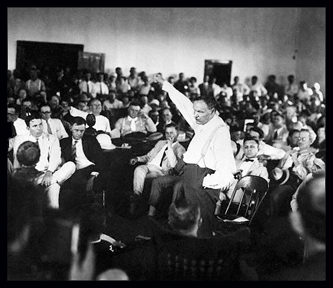
Darrow presenting evidence during the Scopes Monkey Trial.
Issuers of news releases and not US Law Reporter are solely responsible for the accuracy of the content.
Terms and conditions, including restrictions on redistribution, apply.
Copyright 1990-2008 US Legal Media Corportation. All Rights Reserved.